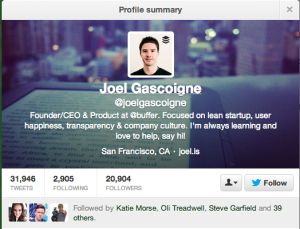
 Buffer and its Founder/CEO Joel Gascoigne today referred disgruntled customers to their main competitor, Hootsuite. This post discusses this display of “lethal generosity.” For those who don’t know, Buffer is a social media productivity tool allowing users to stock up or fill up a buffer of content to share that will then be disseminated over time on various social media platforms you connect to their service. This way, one’s followers will not be overwhelmed by a number of updates at once followed by complete silence. I have personally found the service useful even if I have not consistently filled up my buffer as of late. Today, I was impressed by the service nonetheless. I got an email from the founder “Joel from Buffer” with an alert about a problem:
[Read more…]
Staple Yourself to the Customer Experience
 Today’s wakeup call was provided by Brian Solis with his new blog post “The 5 Pillars of New Media Strategy.” Brian argues convincingly that we all should stop looking for a magic formula or success recipe to guide us in our social media travails by simply arguing that it all depends on who we are serving or building a meaningful relationship with. While I myself occasionally fall prey to the temptation to offer list type “secrets” such as in “3 Keys To Social Success,” I do agree that too much of the focus is placed on the social media delivery side. As a consequence, the tendency is to be less concerned about how our social media efforts will be received by customers. [Read more…]
What Social Media Can Do
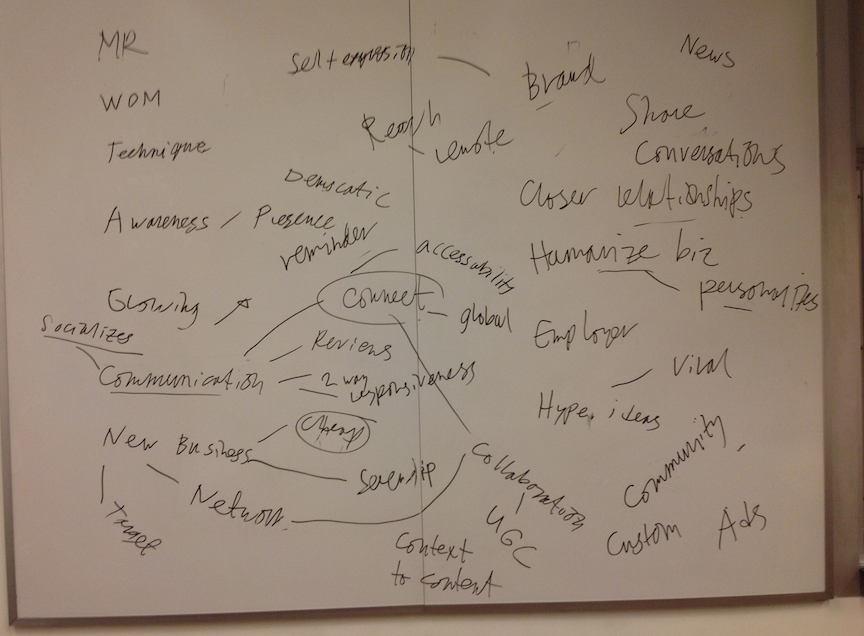
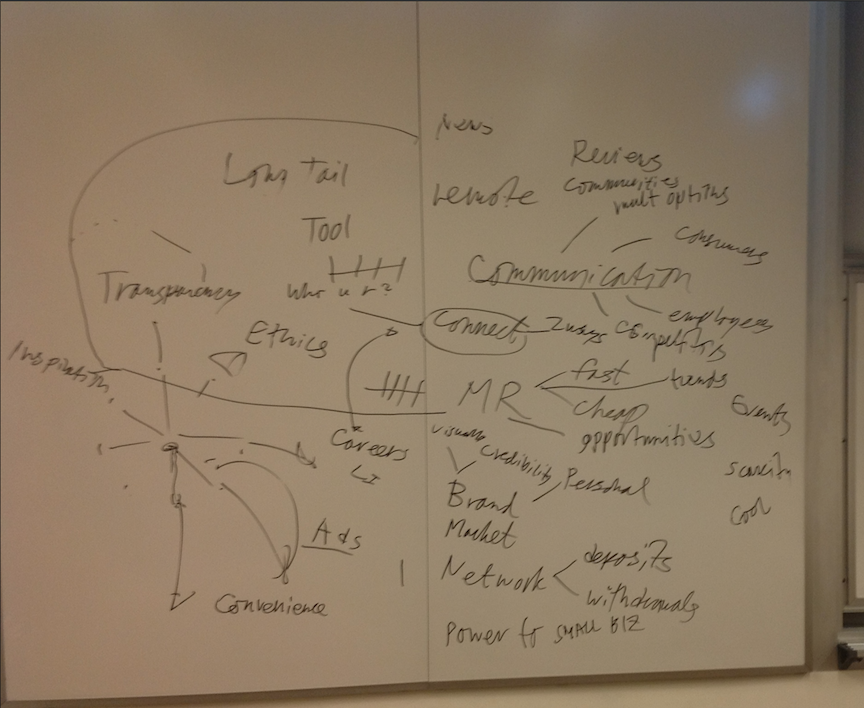
In my first social media marketing classes today, students were asked to identify various uses of social media, preferably with a business use case in mind. If you cannot read my handwriting… here comes some of the prominent uses of social media:
- Communication/Conversations
- Connection/Network
- Humanization/Personalization
- Marketing Research/Opportunity Identification
- Brand presence/Awareness creation
- Reminders about ones existence
- Employee relations and employer branding
- Collaboration
- Communities
- News
Social media is quite multifaceted in other words! Not bad, huh? So, are you leveraging most of these uses or are you limiting yourself?
Selling Social Media to CEO Laggards
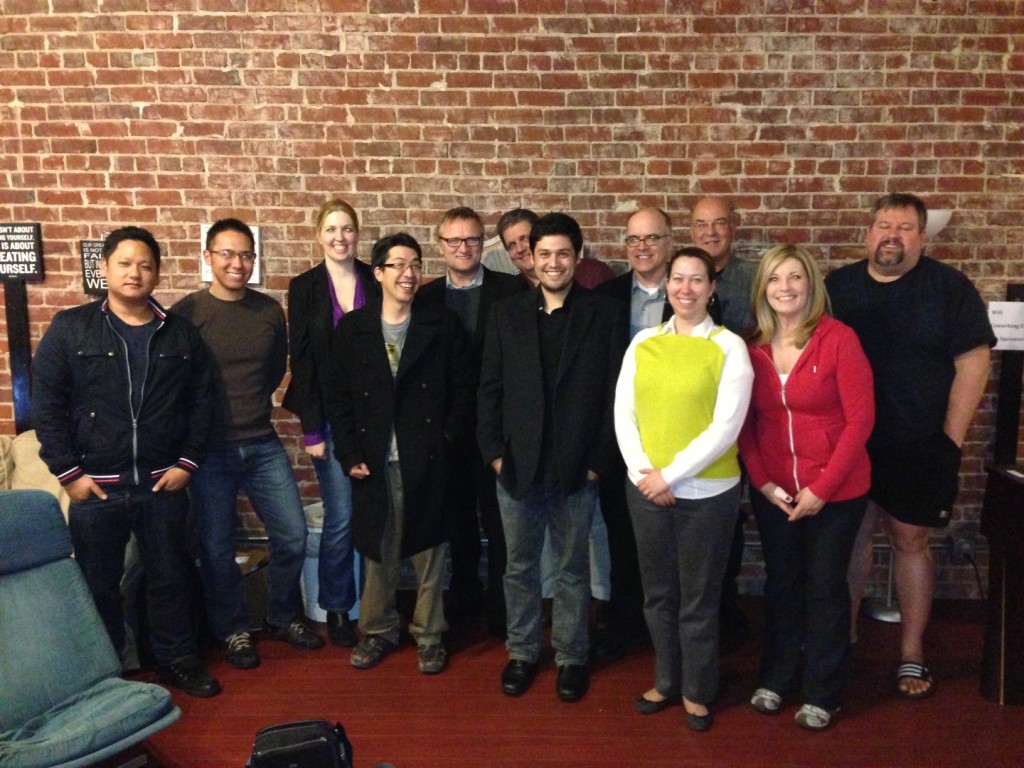
Social Media Campfire recently asked me to share some tips on how the value of social media can be effectively communicated to CEOs and other decision makers who are genuinely skeptical towards the business value of social media. It turned out to be a very interesting evening also for me as the Social Media Campfire participants had plenty of insights to share on this topic as well based on their extensive experiences trying to get the message across. Based on our discussion, one thing that I think is noteworthy, is the one of overcoming the pride factor of CEOs who have been truly skeptical.
Now we are dealing with True Laggards
Given that social media no longer can be considered a new phenomenon, one thing to recognize is that executives who are still holding out by refusing to adopt any social media tools for business purposes represent a shrinking group of executives that could only be classified as true laggards in the adoption process. One implication of this is that for them to change their minds, it is going to take a considerable amount of persuasion as many of them likely have expressed deep skepticism toward social media now for a number of years. Thus, they would have to swallow some pride in order to make such an adjustment and for some, this may not come easily.
One way of dealing with this concern is to give them something to take pride in at the same time as they start adopting social media. For example, one can acknowledge that some of the critiques of social media that many skeptics have expressed could have been at least partially warranted. Security issues of an employee sharing too much information have hurt some companies. Others have indeed suffered from employees wasting too much time on social media without much return on their investment to show for it, at least not in the short term. Customers already suffering from information overload not wanting to connect with suppliers on an ever-increasing number of social media platforms. Etc. This way, executives may be better able to start a more nuanced discussion today regarding how social media potentially could add value to their business and in what ways they should act in order to avoid the traps.
A big thanks to all participants at the Social Media Campfire and to the hosts Kathi Kruse, Marieke Hensel, and Chris Voss plus the beautiful locale at Coworking Fullerton / Branding Personality and for more about our discussion, please also check out the recap by Kathi Kruse!
Seller Beware and Persuasion by Ambiverts
Last week, Daniel H. Pink gave a talk to Linked Orange County at the Irvine Barclay Theatre where he shared some insights from his new book “To Sell is Human.” In the following, I comment upon some of these ideas or findings:
1 in 9 Work in Sales
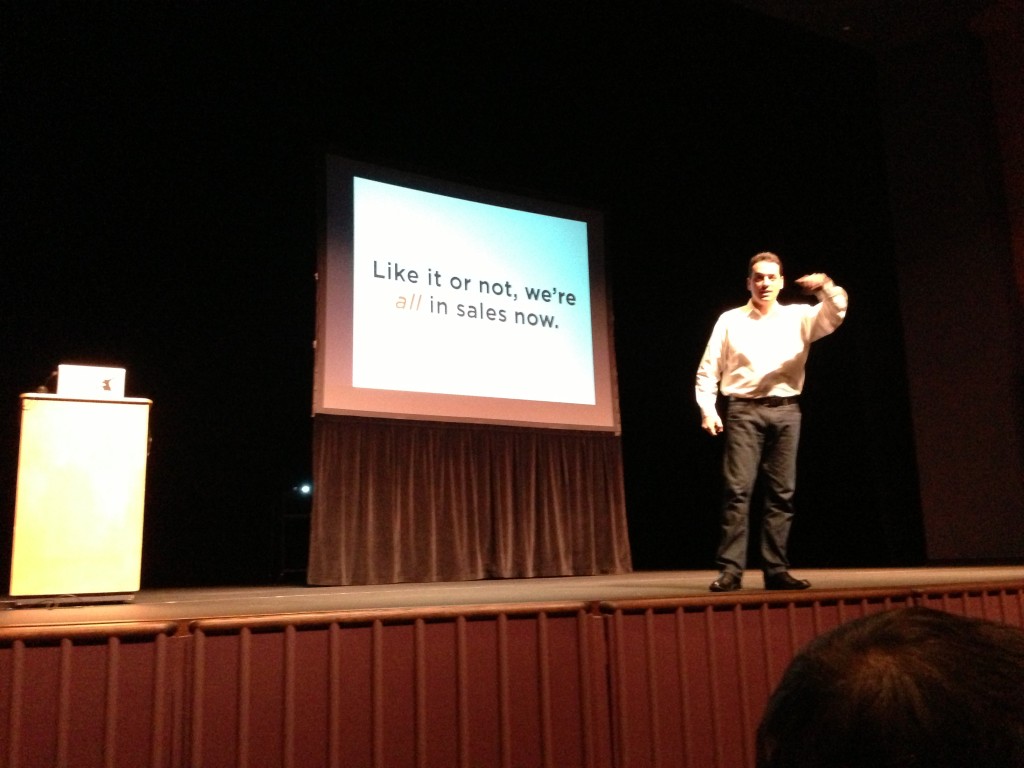
Pink started out by stating that the number of salespeople haven’t changed with the emergence of technology. 1 in 9 professionally active Americans work in sales and that ratio has stayed the same over several decades. Perhaps that is true but I also think that a key question is how the nature of the sales profession has changed and how technology is playing an increasingly crucial role to facilitate the sales cycle for salespeople. That being said, it is indeed noteworthy that his studies confirm that so many people still today have their primary professional focus on sales.
Aren’t We All in Sales?
Then Dan Pink addressed the other part of the pie, the 8 of 9 professionals who are not having variations of the word sales on their business cards. He argued that those people, too, are in sales as his research shows that professionals today spend about 40% of their time convincing and persuading others, whether they be bosses, partners, suppliers, etc, to get them to do or to support various activities, goals, etc. That we are all engaged in sales to various degrees may be worth emphasizing lest we forget. This should serve more as a reminder than as a news alert to many, I presume, at least to my students (I hope!).
Seller Beware!
In line with what many others have pointed out in the recent years, Pink noted the increasing power of buyers armed with more realtime access to ever-more information to aid their shopping comparison processes. Dan Pink raised the bar further in this information arms race, though, when he argued that buyers now not only have achieved information parity with sellers but that they actually in many cases now know more about the market than the seller, even if the latter lives and breathes the market every day! Thus, the call for a “Seller Beware” alert as some naïve and unsuspecting sellers may otherwise be taken advantage of. Talk about a role reversal! I do believe that this is an interesting point as some sellers may have become so complacent thinking they know their industry inside and out so that they are no longer closely attuned to trends and competitive moves, at least not as much as some very motivated buyers may be.

If this were the concern of just a few buyers it may not be so harmful to a seller. However, we could expect many of these well-informed buyers using new technologies to disseminate such information in increasingly effective ways to guide also other, more mainstream, buyers to the best deals in town. Clearly, some such über-informed buyers may turn, or are turning, their market expertise into bona fide businesses themselves and could perhaps no longer be accurately classified as mere buyers.
Persuasive Selling by Ambiverts

Another issue raised by Dan Pink that stood out to me was the research into the relationship between the degree to which a salesperson is extrovert and salesperson performance. Citing some fascinating recent research by Adam M. Grant* at the Wharton School, it was found that the best performers were neither extroverts nor introverts, but rather those salespeople displaying a little bit of both (or neither?). Hence, such salespeople could be labeled as being ambidextrous in this regard, or “ambivert” as Grant calls it in his research. If this finding holds up in more studies, it finally may signal the end of hiring and promoting salespeople based on their extrovert nature in favor of those who keep a somewhat lower profile. Even if there are many other books on sales (e.g., Consultative Selling) which call for a significant listening dimension among salespeople, Pink does a good job in illustrating how an “ambivert” salesperson can operate successfully. At least for large parts of their interaction with clients, salespeople need to allow for sincere listening and learning about the true customer needs at the same time as good salespeople also ought to know when to make their moves, an important aspect where the complete introverts may miss the boat.
* Grant, A. M. 2013. Rethinking the extraverted sales ideal: The ambivert advantage. Forthcoming in Psychological Science.
Brian Solis virtually at Chapman University
Recently, Brian Solis, Principal Analyst at the Altimeter Group, took the time to share some of his insightful perspectives with my Internet/Social Media Marketing class via a Skype conversation. Please check out the video and/or read the interview excerpts further below.
From Social Commerce to Syndicated Commerce
Brian Solis suggests that the meaning of social commerce depends on your vantage point and will be different based on whether you are focusing on information or monetization:
“Information commerce is priceless and that’s what makes social media so valuable. The more conversations, the more potential you have for influence, the more positive experiences you can promote, the better the influence aids in awareness, consideration, pre- and post-commerce.”
When I Almost Kissed Amber Naslund
Can’t see the video, please click here
Amber Naslund, or @AmberCadabra as she is known on Twitter, coauthored “The NOW Revolution” (with Jay Baer) which details how businesses can get faster, smarter, and more social. In this video interview, she offers her take on the role of social media in B2B (business-to-business) marketing. She also gets very excited to the extent that we almost kiss after my question at 1:28, check it out!