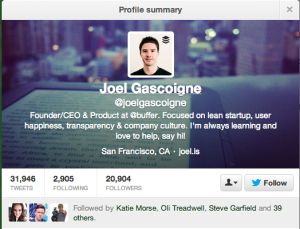
 Buffer and its Founder/CEO Joel Gascoigne today referred disgruntled customers to their main competitor, Hootsuite. This post discusses this display of “lethal generosity.” For those who don’t know, Buffer is a social media productivity tool allowing users to stock up or fill up a buffer of content to share that will then be disseminated over time on various social media platforms you connect to their service. This way, one’s followers will not be overwhelmed by a number of updates at once followed by complete silence. I have personally found the service useful even if I have not consistently filled up my buffer as of late. Today, I was impressed by the service nonetheless. I got an email from the founder “Joel from Buffer” with an alert about a problem:
[Read more…]
Staple Yourself to the Customer Experience
 Today’s wakeup call was provided by Brian Solis with his new blog post “The 5 Pillars of New Media Strategy.” Brian argues convincingly that we all should stop looking for a magic formula or success recipe to guide us in our social media travails by simply arguing that it all depends on who we are serving or building a meaningful relationship with. While I myself occasionally fall prey to the temptation to offer list type “secrets” such as in “3 Keys To Social Success,” I do agree that too much of the focus is placed on the social media delivery side. As a consequence, the tendency is to be less concerned about how our social media efforts will be received by customers. [Read more…]
Voice of the B2B Customers’ Customers
In the early 1990’s, companies started to listen more systematically to the “voice of the customer” (VOC)* after the quality movement made it clear that companies had room for improvement in this regard. Companies could more precisely identify how to provide the most value by dissecting the customers’ voice so that they could hierarchically structure and prioritize their needs. Many companies learned from this exercise and customers benefited.
However, VOC also missed the boat in one major way. The voice of the customer approach assumes that the customer is talking to you. But what if the customer is either unwilling or unable to articulate anything? This is the “silence of the customer” which could be equally if not more important than what customers actually say such as when “96% of customers who are unhappy don’t complain.”
Thinking about it, in a B2B context this could also mean that social media listening efforts could be misdirected if listening is limited only to direct customers. Instead of trying to listen to direct customers when they may not have anything to say, companies could be better off holding their ears close to the ground where the customers of the customers interact instead. Why? Well, imagine if we could hear customers’ customers concerns. Wouldn’t that put us in a better position to also predict what our customers’ needs are, articulated or not?
* Abbie Griffin & John R. Hauser (1993), “The Voice of the Customer,” Marketing Science, Vol. 12, No. 1, Winter 1993.
3 Keys to Social Success
There are many guidelines out there when it comes to how one can achieve success through the use of social media. To me, three core perspectives stand out as being particularly critical.
- Long term perspective. Without the patience to develop long-term relationships and networks, one is likely to fail. To strive for short-terms results may not be wrong per se but it cannot come at the expense of long-term customer satisfaction.
- Generous approach. Give more than you take and you will be offered plenty in return. This is related to the long-term perspective as well and the generosity is also about proactive sharing, offering ideas, connections, and resources to those in your network you believe would benefit from them without them asking for them.
- Human appearance. Trying to sound corporate, professional, or intellectual can on social media come across as being snobby and standoffish and is thus also less likely to engender any interest in interactions by other parties. A more casual, informal, and sometimes humorous communication style is a much more effective way to get other people to open up and be willing to develop better relationships with you. In the end, it may very well be seen as being unprofessional to be too professional!
What do you think? Other factors you think should be a top priority as you find your approach on social media?
Social B2B Relationships
The fact that many business-to-business (B2B) relationships are characterized by long-term norms of trust and commitment should not be news to either academics or practitioners. The value of establishing loyal partnerships between buyers and sellers to ensure consistent delivery of customer satisfaction has become increasingly evident. Such partnerships typically involve multiple people in each company having multiple relationships with people in the other company. Over time, such social processes make a specific buyer-seller relationship difficult to break as the the organizational boundaries begin to blur. Over time, many staff in boundary-spanning jobs experience a role conflict in that they almost forget which company they work for or at least which company’s goals they hold, or should hold, closest to their hearts, at the same time as this is for the good of the whole partnership.
Even if most would agree with the above statement, now with the emergence of a plethora of often free social media and networking technologies that are getting easier and easier to use by the day at the same time as they become more and more powerful, some still question the potential value of social media in a B2B context. This is puzzling. Yes, there may be too many platforms to choose from. Yes, there could be situations where social media may not be applicable. But still. What could be wrong with having more tools as your disposal to further strengthen and develop existing relationships between buyers and sellers?
In a B2B context, you often hear naysayers say things like: “I don’t need social media to manage my customer relationships, I only have a handful of customers to manage and if I have a problem, I just pick up the phone.” Still, wouldn’t it be helpful to also know what is going on in the lives of your customers when you don’t have a problem? Perhaps they have a problem, a problem they may even voice on social media, and you are nowhere near to pick up the signal. That sounds like a problem to me. Or, what do you think?
Seth Godin says Keep Firing Your Customers
I had the honor of participating in Mitch Jackson’s Spreecast with Seth Godin (segment beginning at 28:45). I took the opportunity to ask if he still supports his earlier claim from Permission Marketing that companies should fire 70% of their customers or if he has revised that notion as technology has evolved to perhaps enable more customers to be served in a cost-effective manner.

Rebirth of the Social Salesperson

100 years ago, the personality and the perceived character of salespeople were key determinants of success as these traits would command both liking and respect.1 However, in Arthur Miller’s 1949 play Death of a Salesman, Willy Loman complained that the sales profession was becoming “all cut and dried” and that you no longer could sell with “personality” or the personal relationships you have with your customers.
Mari Smith and The New Relationship Marketing
 After Wednesday’s Back-to-School Night at our kids’ Elementary school, I made it slightly late to a very educational and entertaining Linked Orange County event with Social media superstar Mari Smith at the Hilton Hotel in Costa Mesa. In what should have been a stop on a book tour (new release date October 25), Mari eloquently laid out the key elements of her upcoming book “The New Relationship Marketing: How to Build a Large, Loyal, Profitable Network Using the Social Web” (not an affiliate link).